




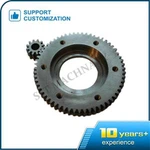

Gear Shaft
SSTmachinery is one of the most professional gear shaft manufacturers in China. Gear shaft refers to mechanical parts that support rotating parts and rotate with them to transmit motion, torque or bending moment. It is generally in the shape of a metal round rod, and each section can have different diameters. The rotating parts of the machine are installed on the shaft.
It is widely used in many industries at home and abroad, such as Oilfield Petrochemical machinery, all kinds of machine tools, all kinds of mechanical processing equipment, engineering machinery, metallurgical equipment, steel rolling machinery, mining machinery, coal mining machinery, textile machinery, marine machinery, shipbuilding industry, aerospace, forklift, elevator, reducer, aircraft manufacturing and so on.
We can provide customers with products of high quality and reasonable price. We can produce gear shafts according to DIN, ANSI, ISO and other standards or drawings.
We also provide customers with the most considerate service and technical support. Contact us immediately and get a quick quotation.
Why Choose Us
Quality Control
Inspection ensures that the quality of goods meets the standards set by the manufacturer, importer, or buyer. This helps to prevent defective or substandard products from reaching the market.
Compliance
Inspection ensures that the goods meet the legal and regulatory requirements of the importing country. Failure to comply with regulations may result in fines, penalties, or even seizure of the goods.
Contractual Obligations
Inspection helps to ensure that the goods conform to the terms of the sales contract, including specifications, quantities, and delivery dates.
Customer Satisfaction
Inspection can help to improve customer satisfaction by reducing the likelihood of defective or damaged products being delivered. This ultimately leads to increased customer loyalty and repeat business.
The gear shaft refers to the mechanical part that supports the rotating part and rotates with it to transmit motion, torque, or bending moment. Generally, it is in the shape of a metal round rod, and each segment can have different diameters. In its most common form, a gear is a round tool with teeth that converts engine speed into torque. The gear is either attached to the gear shaft or is a part of the gear shaft. Many of the more typical gears will include a hole in their center that is introduced as a bore through which the gear shaft is mounted. Once the gear shaft is cycled, the gear will also move.


The Role Of The Gear Shaft In The Gearbox
Cylindrical gears play a crucial role in the operation of wind turbines, especially inconverting the rotational motion of the wind turbine blades intelectrical energy. Here'show cylindrical gears are applied in wind power:
Step-up Gearbox:
Wind turbines operate most efficiently at a relatively high rotational speed, while electricity generation typically requires lower speeds but higher torque. Therefore,a gearbox with cylindrical gears is used to step up the rotational speed of the turbine rotor to a speed suitable for the generator. This step-up gearbox increases the efficiency of power generation byallowing the generator to operate within its optimal speed range.
Transmission of Torque:
Cylindrical gears transmit torque from the wind turbine rotor to the generator. As the wind rotates the turbine blades, the main shaftconnected to the rotor turns. The rotational motion of the main shaft is then transmitted through the gearbox to the generator via cylindrical gears.These gears ensure efficient power transmission while withstanding high torque loads generated by the wind.
Speed Regulation and Control:
The gearbox in a wind turbine also serves to regulate and control the rotational speed of the generator. By adjusting the gear ratio, the gearbox can optimize the generator speed to match the varying wind conditions and maintain a constant electrical output. Cylindrical gears provide the necessary precision and reliability for this speed regulation function.
Load Distribution:
Wind turbines are subject to varying wind conditions, which can result in fluctuating loads on the gearbox and other components. Cylindrical gears help distribute these loads evenly across the gearbox, reducing stress concentrations and minimizing wear and fatigue.
Durability and Reliability:
Wind turbines operate in harsh environmental conditions, including high winds, temperature variations, and exposure to moisture and dust. Cylindrical gears used in wind turbine gearboxes are designed to withstand these challenging conditions while maintaining reliable performance over the long term. Proper material selection, heat treatment, and surface coatings enhance the durability and reliability of these gears.
Maintenance and Serviceability:
Cylindrical gears should be designed for ease of maintenance and serviceability. Accessible design features, such as removable covers and inspection ports, facilitate routine maintenance tasks such aslubrication and gear inspection. This ensures optimal performance and extends the service life of the gearbox and the wind turbine as a whole.
What Is The Processing Of The Gear Shaft And Its Difficulties
The processing of gear shafts involves the manufacture of a rotating component that is used to transmit torque and power between two or more rotating shafts. The gear shaft typically has a series of gear teeth machined into its surface, which mesh with corresponding gear teeth on another rotating component to transmit power and motion.
The processing of gear shafts involves several steps, including material selection, design and engineering, machining and heat treatment, and finishing operations. Some of the difficulties associated with processing gear shafts include:

Precision machining
Gear shafts must be machined to very precise tolerances to ensure that the gear teeth mesh correctly and the shaft operates smoothly. This requires advanced machining techniques and equipment, such as CNC machines and precision grinders.
Heat treatment
Gear shafts must be heat-treated to harden and strengthen the surface of the metal, which can be a complex and delicate process. The heat treatment must be carefully controlled to avoid warping or distorting the shaft.


Surface finish
The gear teeth on the shaft must have a precise surface finish to ensure smooth operation and minimize wear. Achieving the correct surface finish can be challenging and may require additional finishing operations, such as grinding or polishing.
Material selection
Gear shafts are often subjected to high stresses and loads, so the material selection must be carefully considered to ensure that the shaft can withstand the required operating conditions. This may involve selecting specialized alloys or materials with specific properties, such as high strength or wear resistance.

Forged Gear Shaft
The forging process is to use the blank to forge the shape of the gear shaft with cross wedge rolling technology. The forged gear shaft not only has high precision, small post-processing allowance, but also high production efficiency.
Normalizing
After the forging is finished, the forged shaft material is firstly normalized, and the warm normalizing process is adopted to avoid affecting the performance of the material, and effectively change the disadvantages of general normalizing, and the product quality is stable and reliable. The purpose of this process is to eliminate the internal stress of forging, refine the grain, improve the cutting performance during machining, and prepare for the final heat treatment to effectively reduce heat treatment deformation.
Rough Processing
In the rough machining stage of the gear shaft, the process will be different according to the specifications of the gear shaft required. This stage includes hollowing out, rough turning and drilling, etc., through which most of the machining allowance of the gear shaft is removed.
Flaw Detection
Carry out preliminary flaw detection on the gear shaft to detect whether there are internal cracks, defects or unevenness to ensure the quality of the product.
Quenching And Tempering Treatment
Due to the large cutting force and heat generated during the rough machining of the gear shaft, the gear shaft generates internal stress. We can eliminate the internal stress through quenching and tempering treatment instead of aging treatment, and at the same time obtain the required toughness.
Semi-Finishing
Before the gear shaft is tempered, rough machining is performed; after quenching and tempering, semi-finishing is required. After semi-finishing, the required gear shaft has reached the required specifications.
Quenching
After semi-finishing, the gear shaft is quenched to achieve the required hardness.
Finishing
After quenching, the gear shaft is finished to eliminate quenching deformation.
Inspection
Detect gear shaft specifications, surface, chemical composition, mechanical properties, mechanical properties and flaw detection, etc.
Working Principle of Gear Shaft
Gears are mechanical, toothed transmission parts used to transmit power and motion between machine sections, and in this post, we explain the various forms of gear shafts available and how they operate. Performance in mated pairs is determined by gears mounted on their teeth and the teeth of another facing gear or toothed part which avoids slippage.
Each gear or toothed part is connected to a machine shaft or base section, so once the driving gear (i.e. the gear that supplies the initial rotational input) circulates along with its shaft section, the driven gear (i.e. the toothed component or gear which is affected by the driving gear and provides the final output) rotates or transforms its shaft component.
Due to the modeling and structure of the gear pair, the transference of moving between the driven shaft and the driving shaft can cause a variation of the rotation direction or movement direction. In addition, if the gears do not have the same sizes, the system or machine experiences a mechanical advantage that permits a modification in the output torque and speed (i.e. the load which results in an object rotating).
Gear shafts and their mechanical features are broadly used throughout the industry to convert motion and power in a variety of mechanical instruments including clocks, instrumentation, and equipment, and to decrease or increase torque and speed in a variety of motorized instruments including motorcycles, automobiles, and machines.
Other design properties including gear shape, construction material, gear pair configuration, and tooth construction and design, help to define the different types of gear shafts available. Each of these gear shafts provides several advantages and behaviors, but the specifications and requirements demanded by a specific motion or power transmission case identify the type of gear shaft most suitable for the application.
Selection Considerations Of Gear Shaft
Gear shafts are used in a variety of mechanical instruments, and, consequently, several various kinds and models are existence. The suitability of each form of gear shaft and its precise design for a power or motion transmission application is based on the requirements and features of the application. Some of the principal characteristics which may be considered when modeling and choosing a gear shaft include:
Operational and Environmental Conditions
The operational conditions of the gear shaft application mainly affect the optimal kind and design of gear as the situations can affect the gear’s operation and durability. Some of the operational states which may affect a gear shaft are the noise and vibration created, the amount of weight applied, and friction and stress that happened on the teeth, while some of the environmental states which may influence a gear shaft contain humidity, temperature, sanitation, and cleanliness.
Gear Shaft Surface Treatments
Some of the surface treatments existence for gear shafts are grinding and heat treatment.
Grinding down the plane of the gear teeth can reduce the amount of noise generated during function, improve the amount of power that can be transferred, and affect the gear’s accurate classification. Although, grinding also increases the overall price of production.
Gear Shaft Construction Material
Gear shafts exist in a variety of construction materials including fiber, cast iron, nylon, steel, and stainless steel with each of these substances providing particular operational and manufacturing advantages.
Gear Shaft Lubrication
If properly and adequately applied, gear shaft lubricants can help to improve the overall lifespan of gear by reducing the fatigue and stress experienced by the gear teeth and body. Both the lubrication method and optimal kind of lubricant are dependent on the specifications and requirements of the application.
When choosing a lubricant, the load pressure capacity, potential lubricant’s viscosity, thermal and chemical stability, anti-foaming, water separating, and corrosion resisting properties within the performance and environmental conditions of the case should be considered. Given the use of the suitable lubricant, some of the advantages are the mitigation of heat produced, reduction of friction between gear teeth, and decreasing the amount of vibration and noise created during the function.
Dimensional Restrictions
Beyond the environmental and operational conditions of the application, gear shafts and their modeling are also restricted by the dimensional factors e.g. physical space of the mechanical system.
Transmission Requirements
Gears are used to transmit the torque and motion between machine elements in mechanical systems. According to the construction and design of the gear shaft used, gears can vary the direction of motion and/or increase the output torque and speed. The features and requirements of the particular cases—i.e. whether they require to modify direction, increase torque or speed, or both—affect the required and optimal gear shaft form, modeling, and configuration.
Design Standards
There are a lot of specifications for systems using gear shafts. But unfortunately, no universal industrial tips exist which specify how a gear shaft should be modeled and created. Usually, gear shafts are constructed either to the norms set by the individual constructors or to suit the model and features of a special system or machine rather than those devices being modeled around a standard gear part.
Our Factory
SST machinery was established in 2010, engaged in two lines of transmission products, machine transmission and hydraulic transmission, like gear, sprocket, pulley, belt and hydraulic fitting, ferrule, adapter, brass fitting, connector ect.
We are not only proceed production strictly with DIN, ANSI, ISO standard and control well for tolerance, but also make products exactly as client's drawing.