



Gear
SSTmachinery is one of the most professional gear manufacturers in China. Gear transmission is widely used. It is an important part of various mechanical equipment, such as automobiles, machine tools, aviation, ships, agricultural machinery, construction machinery, etc. all kinds of gear transmission should be used in daily life.
Gear transmission is a mechanical transmission that uses the meshing of the teeth of two gears to transmit power and motion. Among all mechanical transmission, gear transmission is the most widely used, which can be used to transfer the motion and power between two shafts not far from each other.
The gear transmission has the advantages of high efficiency, reliable operation and long service life. The gear transmission with correct and reasonable design and manufacture and good use and maintenance can work very reliably, and the service life can be as long as 10 or 20 years.
We can provide customers with products of high quality and reasonable price. We can produce gears according to DIN, ANSI, ISO and other standards or drawings.
We also provide customers with the most considerate service and technical support. Contact us immediately and get a quick quotation.
Why Choose Us
Quality Control
Inspection ensures that the quality of goods meets the standards set by the manufacturer, importer, or buyer. This helps to prevent defective or substandard products from reaching the market.
Compliance
Inspection ensures that the goods meet the legal and regulatory requirements of the importing country. Failure to comply with regulations may result in fines, penalties, or even seizure of the goods.
Contractual Obligations
Inspection helps to ensure that the goods conform to the terms of the sales contract, including specifications, quantities, and delivery dates.
Customer Satisfaction
Inspection can help to improve customer satisfaction by reducing the likelihood of defective or damaged products being delivered. This ultimately leads to increased customer loyalty and repeat business.
A gear is a rotating circular machine part having cut teeth or, in the case of a cogwheel or gearwheel, inserted teeth (called cogs), which mesh with another toothed part to transmit torque.
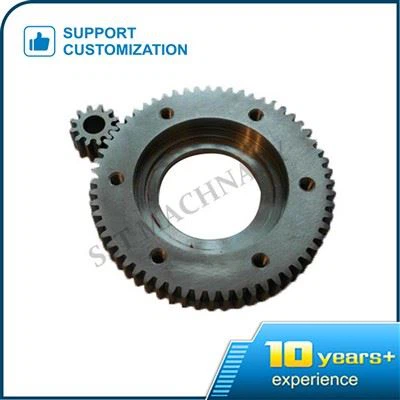





Parts of a Gear
Axis: The axis of revolution of the gear, where the shaft passes through
Teeth: The jagged faces projecting outward from the circumference of the gear, used to transmit rotation to other gears. The number of teeth on a gear must be an integer. Gears only transmit rotation when their teeth mesh and have the same profile.
Pitch Circle: The circle that defines the “size” of the gear. The pitch circles of two intermeshing gears must be tangential so that they can intermesh. If the two gears were instead two disks driven by friction, the circumference of those disks would be the pitch circle.
Pitch Diameter: The pitch diameter refers to the working diameter of the gear, a.k.a., the diameter of the pitch circle. You can use the pitch diameter to calculate how far away two gears should be: The sum of the two pitch diameters divided by 2 corresponds to the distance between the two axes.
Diametral Pitch: The ratio of the number of teeth to the pitch diameter. Two gears must have the same diametrical pitch to mesh.
Circular Pitch: The distance from a point on one tooth to the same point on the adjacent tooth, measured along the pitch circle. (so that the length is the length of the arc rather than a line).
Module: The module of gear is simply the circular pitch divided by pi. This value is much easier to handle than the circular pitch because it is a rational number.
Pressure Angle: The pressure angle of a gear is the angle between the line that defines the radius of the pitch circle and the point where the pitch circle intersects a tooth, and the line tangent to that tooth at that point. Standard print angles are 14.5, 20, and 25 degrees. The pressure angle affects how the gears touch and how the force is distributed along with the tooth. Two gears must have the same contact angle for meshing.
Different Ways To Use Gears


Gears For Speed
In this simple gearbox, I've got (from right to left) a large gear wheel with 40 teeth, a medium wheel with 20 teeth, and a small wheel with 10 teeth. When I turn the large wheel round once, the medium wheel has to turn twice to keep up. Similarly, when the medium wheel turns once, the small wheel has to turn twice to keep up. So, when I turn the large gear wheel on the right, the small wheel on the left turns four times faster but with one quarter as much turning force. This gearbox is designed for increasing speed.
Gears For Force
If I power the same gearbox in the opposite direction, by turning the small wheel, I'll make the large wheel spin a quarter as fast but with four times as much force. That's useful if I need to make a heavy truck go up a hill, for example.
Worm Gears
Here I'm using an electric motor (the gray box on the right) and a long screw-like gear (called a worm) to drive a large gear wheel (known as a worm wheel). This arrangement is called a worm gear or worm drive. It reduces the speed of the motor to make the large wheel turn with more force, but it's also useful for changing the direction of rotation in gear-driven machinery. It does the same job as a normal pair of gear wheels but takes up much less space.
Rack And Pinion Gears
You've probably seen one of these in cliff- and hill-climbing rack railroads, but they're also used in car steering systems, weighing scales, and many other kinds of machines as well. In a rack and pinion gear, a slowly spinning gear wheel (the pinion) meshes with a flat ridged bar (the rack). If the rack is fixed in place, the gear wheel is forced to move along it (as in a railroad). If the gear is fixed, the pinion shifts instead. That's what happens in car steering: you turn the steering wheel (connected to a pinion) and it makes a rack shift from side to side to swivel the car's front wheels to the left or the right. In simple weighing scales, when you load a weight on the pan at the top, it pushes a rack straight downward, causing a pinion to rotate. The pinion is attached to a pointer that rotates as well, showing the weight on the dial.
Sun And Planet Gears
If you need to convert reciprocating (back-and-forth) motion into rotation, you normally do it with a crankshaft and connecting rod; that's how pistons drive the wheels on steam engines. But you can do the same thing with gears. In this arrangement, a small gear called a planet (which, it's important to note, is fixed to a rod so that it cannot rotate) is moved around a second (usually bigger) gear called a Sun. As the rod moves the planet back and forth, the Sun spins around.
Bevel Gears
If you want to change the direction of a machine's power through 90 degrees (or indeed any other angle), you can use angled gear wheels, called bevel gears. Typically they look like cut-off cones and the basic principle is always the same: power coming in from one direction is transformed so it goes out in another direction. You could achieve this with an ordinary pair of gear wheels, but a bevel gear has more teeth (and more area of each tooth) in contact at a time. This is smoother and quieter, reduces stress, and makes the gear better able to cope with varying loads. In this photo, which is a closeup of the gearbox in the very top photo, you can see different bevel gears hard at work.
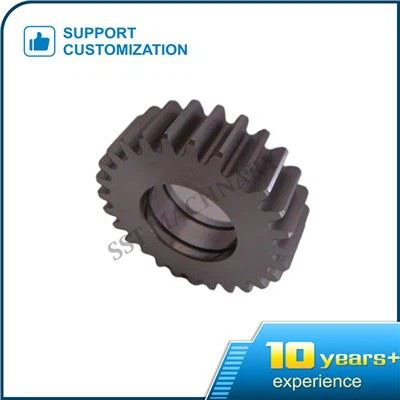
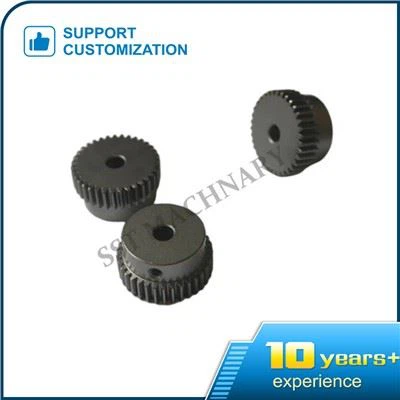
Spur Gear
Spur gears are one of the most popular types of precision cylindrical gears. These gears feature a simple design of straight, parallel teeth positioned around the circumference of a cylinder body with a central bore that fits over a shaft.
Helical Gear
Helical gears are one type of cylindrical gear with a slanted tooth trace. Compared to spur gears, they have a larger contact ratio and excel in quietness and less vibration, and are able to transmit large force.
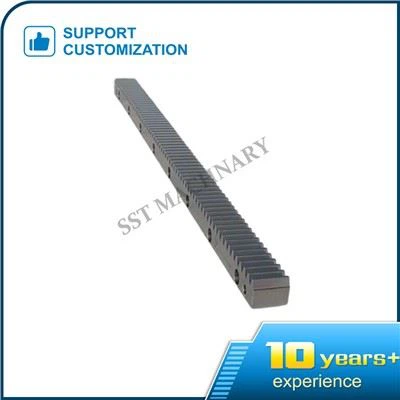
Gear Rack
Same-sized and shaped teeth cut at equal distances along a flat surface or a straight rod is called a gear rack.
Bevel Gear
A bevel gear is a toothed rotating machine element used to transfer mechanical energy or shaft power between shafts that are intersecting, either perpendicular or at an angle. This results in a change in the axis of rotation of the shaft power.
Spiral Bevel Gear
Spiral bevel gears are bevel gears with curved tooth lines. Due to the higher tooth contact ratio, they are superior to straight bevel gears in efficiency, strength, vibration, and noise. On the other hand, they are more difficult to produce.
Screw Gear
Screw gears are a pair of same hand helical gears with the twist angle of 45° on non-parallel, non-intersecting shafts. Because the tooth contact is a point, their load carrying capacity is low and they are not suitable for large power transmission.
Double Helical Gear
Double helical gears are a variation of helical gears in which two helical faces are placed next to each other with a gap separating them. Each face has identical, but opposite, helix angles.
Herringbone Gear
Herringbone gears are very similar to the double-helical gear, but they do not have a gap separating the two helical faces.
Hypoid Gear
Hypoid gears look very much like spiral bevel gear, but unlike spiral bevel gears, they operate on shafts that do not intersect.
Miter Gear
Miter gears are bevel gears with a speed ratio of 1. They are used to change the direction of power transmission without changing speed. There are straight miter and spiral miter gears.
Worm Gear
A screw shape cut on a shaft is the worm, the mating gear is the worm wheel, and together on non-intersecting shafts is called a worm gear. Worms and worm wheels are not limited to cylindrical shapes.
Internal Gear
Internal gears have teeth cut on the inside of cylinders or cones and are paired with external gears. The main use of internal gears is for planetary gear drives and gear-type shaft couplings.
High Transmission Power
Gears, especially spur gears, can handle significant power transmission. They are suitable for applications that require high torque transmission and power transfer.
Fixed Center Distance
Gears have a fixed centre distance between the mating gears. This design ensures stable operation and contributes to the longevity of the gear system. Gears with a fixed centre distance are commonly used in compact structures and high-reliability mechanisms.
Gear Tooth Size
The gear teeth size is typically expressed using the module (m), a unit specified by the International Organization for Standardization (ISO). However, other methods may also denote the size of gear teeth.
Module
The module multiplied by pi (π) gives the pitch diameter (d). The pitch diameter is the diameter of the imaginary circle that passes through the gear teeth. It determines the distance between adjacent teeth.
Pressure Angle
The pressure angle is a parameter that determines the shape of the gear teeth. It represents the inclination of the gear tooth surface. The standard pressure angle is generally 20 degrees, although 14.5-degree pressure angle gears were common in the past.
Number of Teeth
The number of teeth on a gear is counted using graphical methods. For example, the gear with ten teeth can be represented as "=10".
Addendum and Dedendum
The height of the gear tooth is determined by the module (m). The International Organization for Standardization (ISO) and the Japanese Industrial Standards (JS) define the gear tooth form, specifically the full-depth tooth.
Applications of Gear
Gears are an industry essential that are used for the transmission of motion and power in clocks, instruments, machinery, vehicles, and industrial equipment. They are engineered to reduce or increase speed in motorized implements and change the direction of power smoothly and efficiently. Since their introduction thousands of years ago, gears have become an essential tool for the innovations and improvements of industry.
Made from highly durable materials, gears play a key role in the productivity of machines and the operations of manufacturing. Each type of gear has varied elements, characteristics, advantages, and properties that meet the requirements and specifications for motion or power transmission. The wide variety and number of gears makes it possible to find a gear for every application.
Setting Rotation Speed
One of the main functions of gears is to change the rotation speed of power with engines being the most common example. Gears regulate power by their ratios with different sizes of gears used to increase or decrease transmitted power by their rotation.
Transmitting Power
During the transmission of power, gears intermesh with other gears without slipping and strongly retain their connections. The motor in a machine may not be designed to move a shaft directly and uses gears to transmit power to the shaft to power a tool.
Change of Torque
Torque is the rotating force that is produced by motors and engines that is adjusted through the use of gears, gear sets, gearboxes, and gear assemblies. Smaller gears produce less torque while large gears produce higher amounts of torque. When a small gear is the drive gear to power a large gear, the amount of torque increases and speed decreases. Taken in reverse, when a large gear is the drive gear and a small gear is the powered gear, the amount of torque decreases and speed increases.
Direction of Power
A common use for gears is the changing the direction of rotation or movement, which is completed by the specific design of gear pairs. The rotational direction of a motor is dependent on the rotation of a shaft with the direction of the rotation capable of being changed by the configuration of the gears.
Gearboxes
Gearboxes are one of the most common uses of gears and are made up of an assortment of gear types contained in a housing. Gearboxes contain worm, bevel, helical, and spur gears that are engineered to change torque, speed, power, motion, and force. Gearboxes are a foundational part of motor driven vehicles and gas powered machinery.
Our Factory
SST machinery was established in 2010, engaged in two lines of transmission products, machine transmission and hydraulic transmission, like gear, sprocket, pulley, belt and hydraulic fitting, ferrule, adapter, brass fitting, connector ect.
We are not only proceed production strictly with DIN, ANSI, ISO standard and control well for tolerance, but also make products exactly as client's drawing.