



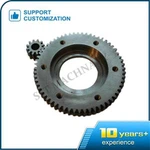

Helical Gear
SSTmachinery is one of the most professional Helical gear manufacturers in China, providing parts for various mechanical products in chemical, textile machinery, food processing, instrumentation, petroleum and other industries.
We can provide customers with products of high quality and reasonable price. We can produce helical gear according to DIN, ANSI, ISO and other standards or drawings.
We also provide customers with the most considerate service and technical support. Contact us immediately and get a quick quotation.
Why Choose Us
Quality Control
Inspection ensures that the quality of goods meets the standards set by the manufacturer, importer, or buyer. This helps to prevent defective or substandard products from reaching the market.
Compliance
Inspection ensures that the goods meet the legal and regulatory requirements of the importing country. Failure to comply with regulations may result in fines, penalties, or even seizure of the goods.
Contractual Obligations
Inspection helps to ensure that the goods conform to the terms of the sales contract, including specifications, quantities, and delivery dates.
Customer Satisfaction
Inspection can help to improve customer satisfaction by reducing the likelihood of defective or damaged products being delivered. This ultimately leads to increased customer loyalty and repeat business.
Helical gears are the mechanical components that transmit motion and power between two parallel shafts. They are called helical gears because the teeth on the gear are inclined at an angle to the face of the gear rather than being perpendicular to it. This design allows the gears to mesh smoothly and quietly, making them ideal for many applications.


Types of Helical Gears
There are several different types of helical gears, which can be distinguished based on the angle of the teeth, the direction of the helix, and the arrangement of the gears. Some common types of helical gears include:
Single Helical Gears: Single helical gears have teeth inclined at an angle to the face of the gear. The angle of the teeth can vary but is typically between 15 and 45 degrees. Single helical gears can be used in pairs, with one gear meshing with the other, to transmit motion and power between parallel shafts.
Double Helical Gears: Double helical gears, also known as herringbone gears, have teeth inclined in opposite directions on opposite sides of the gear. This allows the gears to mesh smoothly and quietly, reducing the axial thrust forces generated by single helical gears.
Spiral bevel gears are helical gears that transmit motion and power between non-parallel shafts. The teeth on spiral bevel gears are inclined at an angle to the face of the gear, and the gears are arranged at an angle to each other. This allows them to transmit motion and power at an angle, making them suitable for applications where the shafts are not aligned.
Hypoid Gears: Hypoid gears are spiral bevel gears with teeth that are offset from the center of the gear. This allows the gears to have a higher gear ratio and a larger contact area between the teeth, which increases their load-carrying capacity and efficiency. Hypoid gears are often used in automotive transmissions.
Manufacturing Process Of Helical Gear
The preparation of the gear blank is the first step in the production process. In order to do this, the raw material (often steel) must be cut to the desired size and shape, and a center hole must be drilled in the blank.
Cutting the gear’s teeth is the next step. Engineers can accomplish this by using a hobbing machine, which removes material from the gear blank and shapes the teeth using a cutting tool called a hob, or by using a gear shaping machine, which works similarly to a broaching device in that it shapes the teeth using a cutting tool.
After cutting the teeth, engineers heat-treat the gear to enhance its strength and longevity. The process involves heating the gear to a specified temperature and then rapidly cooling (quenching) it to harden the material. The gear is then tempered to increase durability and reduce brittleness.
After heat treatment, engineers finish the gear using various methods such as grinding, polishing, and honing to ensure precise measurements, surface polish, and the correct tooth profile needed for its intended function.
To guarantee that the gears satisfy the required requirements, quality control procedures are implemented throughout the manufacturing process. This involves measuring the gear’s size, tooth profile, and surface finish using sophisticated metrology instruments. In order to assess a gear’s performance and load-bearing capability, it may also undergo a load test.

How Helical Gears Work
The mechanical advantage of helical gears, which is the ratio of output torque to input torque in a system, is based on the gear ratio. This ratio is determined by comparing the speed of the final gear to the speed of the initial gear in a gear train. The principle of conservation of energy is central to understanding this relationship. Simplifying this analysis involves examining the power preserved within the system, which connects the angular velocities of the gears to their respective torques.
Helical gears feature teeth set at a specific angle relative to the shaft and gear face. When the teeth engage, the initial contact occurs at one end, gradually extending as the gears rotate until the teeth are fully meshed. This gradual engagement, with multiple teeth in contact at once, allows the gear to support heavier loads.
Thanks to this load-sharing and gradual engagement, helical gears operate more smoothly and quietly compared to spur gears. This makes them ideal for use in virtually all automotive transmissions. Additionally, the angled teeth of helical gears require them to be arranged in a staggered or zigzag pattern to mesh properly with the teeth of adjacent gears.
While the inclined angle of helical gear teeth improves performance, it also introduces sliding contact that generates axial forces and heat, which can reduce efficiency. The angled teeth create a thrust load on the gear during meshing. To manage this thrust force, helical gear systems require bearings designed to support rotation and withstand these axial forces. These bearings, which are typically thrust or roller bearings, are generally larger and more costly than the plain bearings used with spur gears, as they must accommodate both radial and axial forces. The magnitude of the axial forces is influenced by the helix angle, which is usually limited to 45 degrees. Larger helix angles can enhance speed and provide smoother motion, but they also increase axial forces.
Gear Geometry and Tooth Profile
The geometry of gear teeth, such as the helix angle and pressure angle, can significantly impact the performance of the gear system. Therefore, engineers must carefully craft the tooth profile to ensure that the gears mesh properly and efficiently convey power and motion.
Load and Torque Requirements
It’s also important to consider the gear system’s torque and load-bearing capacity needs. The gear system must be built to withstand the forces that will be applied to it and perform dependably in these circumstances.
Lubrication and Maintenance
Helical gears’ long-term performance and dependability depend on proper lubrication. Properly greasing the gear system with the appropriate type and quantity of lubricant and conducting regular maintenance are critical to ensuring that the gears function as intended.
Noise and Vibration Mitigation Strategies
Helical gears don’t produce as much noise and vibration as other gear types, but they may still need additional noise and vibration mitigation techniques, including the use of sound-absorbing materials or vibration-damping mounts.
Common Failure Modes and Prevention
Finally, it’s critical to understand typical helical gear failure modes such as tooth wear, to pit, and scuff. Using proper design, lubrication, and maintenance procedures can help engineers avoid these problems and increase the lifespan of the gear system.
Advantages of Helical Gears
Reduced Noise and Vibration
Helical gears are more advantageous than other forms of gear, such as spur gears, in that they generate less noise and vibration. This is due to the helical gears’ angled teeth, which allow for a more gradual contact between the gears, lowering the force of the impact and producing less noise and vibration.
Improved Efficiency and Load-bearing Capacity
Because of their wider contact area than other gear types, helical gears are able to support more weight. Along with increasing the gear system’s efficiency, the inclined teeth produce a smoother transmission of force and motion.
Smoother Operation and Better Torque Transfer
The progressive contact between the helical gears’ teeth also produces smoother functioning, which lessens gear wear and tears and increases gear lifespan. The teeth’s helix design also enables a more uniform load distribution, which improves torque transfer and raises reliability.
Compatibility with High-speed Applications
As helical gears can transmit power and motion more effectively than other types of gears, they are ideal for high-speed applications. The helical gears’ angled teeth also lessen the effect of shock loads, which makes them perfect for high-speed, high-torque applications.
Normal Circular Pitch
The circular pitch (p) is the distance between corresponding points on adjacent teeth along the pitch circle or pitch line.
Circular Thickness
Circular thickness (t) refers to the arc length between the two sides of a gear tooth at the pitch circle.
Helical Angle
The helical angle is the angle between the involute tooth shape and the transverse plane (the plane of rotation) at the pitch radius.
Pitch Diameter
The pitch diameter is the diameter of the circle at which the pitch is measured, normal to the tooth or perpendicular to it.
Helix's Direction
Also known as Lead, this term describes the axial advance of the tooth per one complete rotation, similar to thread pitch.
Pitch Circle
The pitch circle represents the effective size of the gear teeth. Its diameter is the number of teeth multiplied by the circular pitch. Unlike the tip and root circles, the pitch circle is an imaginary circle used as a reference.
Circle Pitch Size
This is the diameter of the pitch circle, also called the pitch circle diameter. It represents the reference circle used to determine the pitch of the gear teeth and corresponds to the outer circumference of the friction wheel.
Transverse Pressure Angle
The transverse pressure angle is the angle formed by the projection of the load onto the plane with respect to the shaft axis.
Centre Distance
This is the standard center distance, which is either extended or contracted to the desired operating center distance.
Addendum (A)
The addendum (A) is the distance from the pitch circle to the tip circle of the gear's tooth. The tooth height (h) measures the distance from the root circle to the tip, and the gear's module (m) determines the total height of the gear.
Outside Diameter
The outside diameter, also known as the tip diameter, is the circumference of the circle formed by connecting the tips of the teeth.
Dedendum
The dedendum of a gear is the distance from the pitch radius to the root radius at the midpoint of one gear tooth.
Whole Tooth Depth
The total depth of a tooth, from the root circle to the tip circle, is obtained by adding the addendum and dedendum.
Root Diameter
The root diameter (R.D.) is the diameter of the circle that encompasses the bottom (root) of the gear tooth gaps.
Contact Ratio
This figure exceeds what is achievable with straight spur gears because it accounts for both the involute tooth overlap and the helical overlap.
Some Key Features Of Helical Gears
Helical Teeth: The distinguishing feature of helical gears is their helical or spiral-shaped teeth. These teeth provide a smooth and gradual engagement, which results in quieter and smoother operation compared to spur gears (gears with straight teeth).
Efficiency: Helical gears are known for their high mechanical efficiency due to the gradual tooth engagement. This reduces wear and minimizes energy losses in the transmission system.
Load Distribution: The helical design allows multiple teeth to be in contact at the same time, which helps distribute the load more evenly across the gear teeth. This load distribution contributes to the gear’s ability to handle high loads.
Smooth Operation: Because of the helical tooth geometry, helical gears produce less vibration and noise during operation, making them suitable for applications where quiet operation is important.
High Precision: Helical gears are known for their precision and accuracy, making them suitable for applications that require precise motion control and positioning.
Versatility: They come in various configurations, including parallel shaft and crossed axis (worm and helical) setups, making them adaptable to different applications and design requirements.
Applications: Helical gears are used in a wide range of industries and applications, including automotive transmissions, industrial machinery, robotics, conveyor systems, and more.
Helix Angle: The angle at which the teeth are cut is known as the helix angle. The helix angle determines the direction of rotation and the thrust forces experienced by the gear. Right-handed helical gears have a clockwise helix angle, while left-handed helical gears have a counterclockwise angle.
Maintenance: Regular maintenance, such as lubrication and periodic inspection for wear, is essential to ensure the continued performance and longevity of helical gears.
Our Factory
SST machinery was established in 2010, engaged in two lines of transmission products, machine transmission and hydraulic transmission, like gear, sprocket, pulley, belt and hydraulic fitting, ferrule, adapter, brass fitting, connector ect.
We are not only proceed production strictly with DIN, ANSI, ISO standard and control well for tolerance, but also make products exactly as client's drawing.