


Sprocket
SSTmachinery is one of the most professional sprocket manufacturers in China, providing parts for various mechanical products in chemical, textile machinery, food processing, instrumentation, petroleum and other industries.
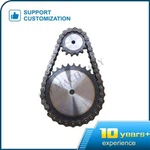
Chain transmission is a transmission mode that transmits the motion and power of the driving sprocket with special tooth shape to the driven sprocket with special tooth shape through the chain.
Chain drive has many advantages, such as accurate average transmission ratio, reliable operation, high efficiency, large transmission power and strong overload capacity. It can work in harsh environments such as high temperature, humidity, dust and pollution.
We can provide customers with products of high quality and reasonable price. We can produce sprockets according to DIN, ANSI, ISO and other standards or drawings.
We also provide customers with the most considerate service and technical support. Contact us immediately and get a quick quotation.
Why Choose Us
Quality Control
Inspection ensures that the quality of goods meets the standards set by the manufacturer, importer, or buyer. This helps to prevent defective or substandard products from reaching the market.
Compliance
Inspection ensures that the goods meet the legal and regulatory requirements of the importing country. Failure to comply with regulations may result in fines, penalties, or even seizure of the goods.
Contractual Obligations
Inspection helps to ensure that the goods conform to the terms of the sales contract, including specifications, quantities, and delivery dates.
Customer Satisfaction
Inspection can help to improve customer satisfaction by reducing the likelihood of defective or damaged products being delivered. This ultimately leads to increased customer loyalty and repeat business.
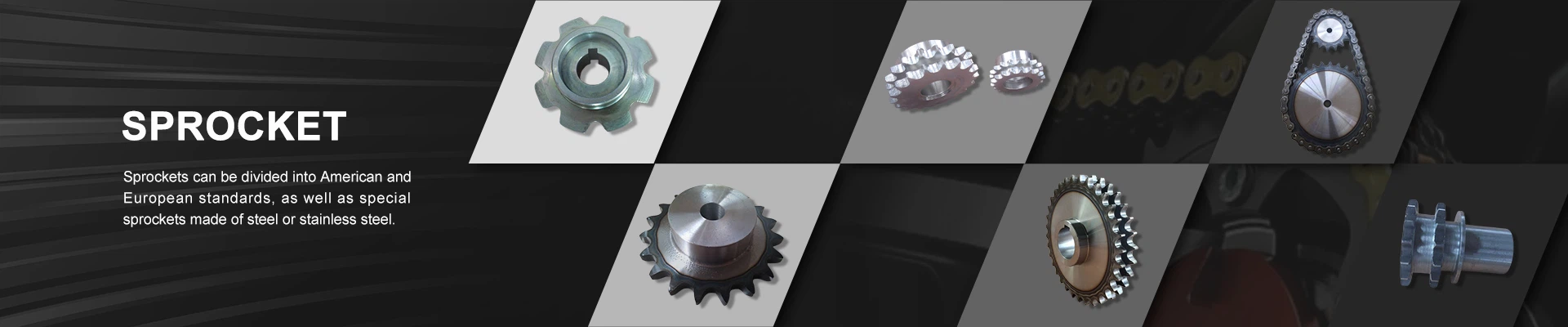
A sprocket is a simple mechanical wheel with teeth or small notches which are designed to rotate and engage with the links of a chain or belt. To be compatible, though, they both need to have the same thickness and pitch.

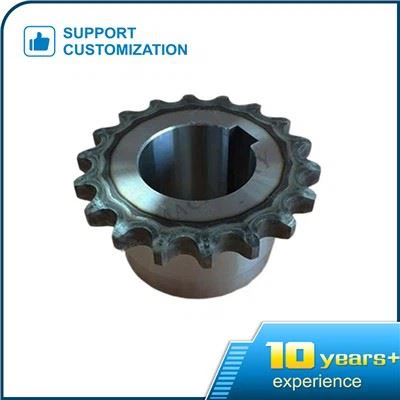


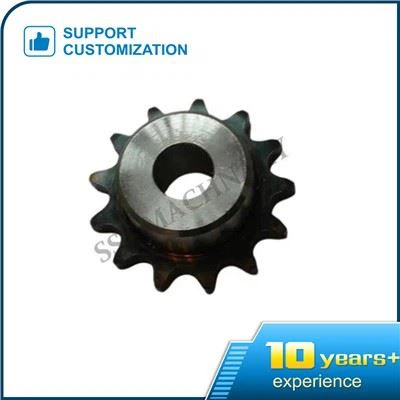


Types Of Sprockets
Double Pitch Sprockets
Similar to standard sprockets except there is half the number of teeth. They are used with a small roller double pitch chain to accommodate longer distances between rollers. Common chain sizes are: 2040, 2050, 2060, 2080, and 2100 or 2042, 2052, 2062, 2082, and 2102 for larger diameters.
Multiple Strand Sprockets
Multi-strand sprockets are used where higher torque and power are needed, or where two or more items are being powered by a common drive shaft. Available in 40 through 160 chain pitch with plain, finished, taper-lock, or QD style hubs.
QD (Quick Disconnect) Sprockets
QD sprockets are used where higher working loads and high clamp loading on the shaft is desirable. They are flanged and use anchor bolts around the circumference. Sprockets with tapered bushings are easy to install and remove, provide clamp force, and align the sprocket.
Taper-Lock Sprockets
Taper-lock sprockets utilize a split through the taper and flange to provide a true clamp on the shaft. A Taper-Lock bushing is retained to the sprocket with set screws. They offer flexibility by allowing multiple-sized bores for a single bushing size.
Steel Split Sprockets
Steel split sprockets are split through the entire radius for easy installation and removal. The halves are held together by bolts. This style is available in pitch sizes 40 through 240, and bore diameters of 3/4 through 6 in.
Double Single Sprockets
Double single sprockets are used in applications where two or more items are powered by a common drive shaft. The space between the plates is wider than a multi-strand sprocket and allows two separate strands of chain to engage without contacting the other. One strand may exit in a different direction than the other.
Idler Sprockets
Idler sprockets are used where the chain may experience slack due to long lengths, where there is a non-adjustable drive shaft, or where the chain has been guided around an obstruction. Using idler sprockets prevents chain whipping and uneven load distribution.
Double Plus Sprockets
Double plus sprockets are specifically designed to be used with Double Plus chain and are in conveyor applications where a product is moving at twice the speed of the drive system powering the conveyor. Benefits include less noise and longer chain life.
Sprockets can have multiple strands of teeth. The most common type of sprocket is a single plate with a single row of teeth, sometimes called a simplex, which accounts for around 70 percent of market applications. Two rows of teeth are called a duplex and account for around 25 percent of applications. Finally, three strands of teeth are called a triplex, which has around five percent of market applications.
The two commonly seen standards for sprockets in North America are the American Standard (ANSI), the International Organization for Standardization (ISO), and the British Standard (BS), which is also known as the European Standard. Japan (JIN), Korea (KS), and Germany (DIN) all have chain and sprocket standards of their own, though they aren’t as prevalent in the United States.
The sizes of sprockets are typically followed by a hyphen and 1, 2, or 3 to designate how many strands of teeth are needed for a chain.

The Many Functions of Sprockets
Power Transmission: The Sprockets are designed to efficiently transfer power via a chain or belt from one rotating shaft to another.
Speed Variation: By changing the size of the sprockets, the speed ratio between input and output shafts can be seamlessly adjusted.
Direction Change: Sprockets have the ability to change the direction of rotation between shafts in an instant.
Torque Amplification: Through gear ratios, sprockets can amplify or reduce torque as needed so that your machine can operate at any level or speed.
Key Components of a Sprocket
Number of Teeth: This refers to the total count of teeth on the sprocket, with each individual tooth engaging with the links of a chain or belt. The number of teeth affects the sprocket's rotational speed and the torque it can transmit.
Pitch Diameter: This is the diameter of the sprocket measured at the point where the chain or belt engages with the teeth. It is crucial for ensuring that the sprocket and chain or belt work together smoothly. The pitch diameter influences the overall size and fit of the sprocket within a mechanical system.
Outside Diameter: This measures the diameter at the tips of the sprocket's teeth. It is essential for determining the sprocket's clearance and ensuring it fits within the designated space in a machine or vehicle.
Pitch: The pitch is the distance between corresponding points on adjacent teeth, usually measured in inches. It must match the pitch of the chain or belt to ensure proper engagement and efficient power transmission.
Applications of Sprockets
Automotive Industry: Sprockets are key components that are used in the automotive parts of engine timing systems, transmission systems, and steering mechanisms.
Manufacturing: Sprockets play a crucial role in various places throughout conveyor systems, assembly lines, and robotics.
Agriculture: Sprockets are found throughout machinery such as tractors, combines, and harvesters for tasks like driving conveyor belts and operating mechanisms.
Mining: Sprockets are employed in heavy-duty mining equipment for tasks such as conveying materials and driving crushers.
Construction
Sprockets are used in equipment like excavators, cranes, and bulldozers for functions such as lifting, digging, and material handling.
Cycling
Sprockets are integral components of bicycles and motorcycles, facilitating gear changes and power transmission.
Military
Sprockets are used on a plethora of equipment to ensure the highest performance of all materials.
HVAC
Sprockets are utilized with HVAC systems to optimize the machine ability on lathes, milling machines, routers, and more.
Design And Processing of Sprocket
When processing, users only need to provide the number of sprocket teeth, pitch and roller diameter to produce. Sprocket design according to GBl244-85 design. Non-standard sprocket on the basis of the user to provide the necessary data, do the following calculations: indexing circle diameter: d points = P/sin180 degrees / Z = P · K, P-pitch, K-number of teeth can check the table. Tooth groove arc radius: Rmin = O.505d, d = roller diameter. Pressure angle Qmin=l20 degrees-90/2; Qmax=140 degrees-90/2. Generally choose Qmax.
The tooth surface arc radius Remin = O.008d; (Z · Z + 180); Remax = O. 12 (Z · Z + 2). Remax is generally used. The position Do of the tooth surface arc radius is on the d-division 0.2P circle. Tooth groove separation S: machine, Smin = 0.08d; non-add, Smin = O.04P. General choice of machine plus tooth groove separation. Pitch angle a=360/Z. Tooth thickness: 0.95 for a single row with an inner section width, and 0.93 for a double row with an inner section width.
- Machining Tooth Profile Of A Forming Knife: Using a forming disc cutter or using a finger-shaped milling cutter, machining a tooth groove on a horizontal or vertical milling machine equipped with a dividing head is a commonly used processing method. Suitable for batch processing of large pitch sprocket.
- Hobbing Process Tooth Profile Method: The tooth groove is processed on the hobbing machine with a hob and is suitable for sprocket processing with a standard sprocket pitch of P=38.1 or less. high productivity. Good accuracy.
- Saddle-shaped Milling Cutter Machining Method: Using a saddle-type milling cutter on a horizontal milling machine equipped with a dividing head, simultaneous milling of two teeth on two adjacent tooth slots is the current toothed sprockets Commonly used processing method. Suitable for medium and small batch production.
- Sprocket Machining Tooth Profile Method: The sprocket spline is machined on the gear shaping machine with a circular disc cutter or a comb cutter. Suitable for single-piece production in small quantities.
- The larger sprocket can also be used for marking, drilling, machining or inserting the tooth profile. It is also a processing method. Obviously, this method is relatively backward, but the large sprocket is limited by the processing equipment and quantity. This method can also be used.
- Recently, some units have used the profiling machine to cut the tooth shape to solve the problem of large-scale sprocket processing and are very creative.
Profile cutting cutting process is as follows:
A. The sprocket to be added to the machine is placed on the index plate, and the sprocket is fixed by the pressure plate and bolt on the mandrel. The gear ring surface must be flat.
B. At any position on the gear ring that has been machined, the depth of cut of the model tooth profile is smaller than that of the design tooth profile by 4-5 mm, and then the squareness of the ruler surface is measured with a square.
C. Measure the distance H between the cut edge of the cut shape and the edge of the finished shaft hole.
D. The depth B needs to be processed. B = measurement size - distance between the edge of the shaft hole and the edge of the index circle.
E. Adjust the size of the connecting rod of the cutting machine, that is, extend a deepening amount on the basis of the original size, and then adjust it to cut according to the template.
F. After cutting a tooth, index with a dial. After cutting three teeth, measure the same side of the same distance. After cutting the fourth tooth, follow the same method to move the same tooth with the same side measurement, and so on.
G. If the difference in the measurement size is greater or the width of the top of the teeth is larger, the wider side can be cut and welded to the other tooth surface for trimming.
H. The tooth surface after cutting is surface-quenched after grinding with a hand wheel. L. Perform other processing.
Our Factory
SST machinery was established in 2010, engaged in two lines of transmission products, machine transmission and hydraulic transmission, like gear, sprocket, pulley, belt and hydraulic fitting, ferrule, adapter, brass fitting, connector ect.
We are not only proceed production strictly with DIN, ANSI, ISO standard and control well for tolerance, but also make products exactly as client's drawing.