




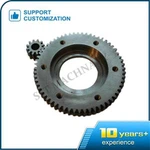

Pulley
SSTmachinery is one of the most professional pulley manufacturers in China.
The advantages of belt pulley transmission are: the belt pulley transmits kinetic energy to mitigate the load impact, the belt pulley transmission operates stably, with low noise and vibration, the belt pulley transmission has simple structure and convenient adjustment, and the belt pulley transmission is not as strict as meshing transmission for the manufacturing and installation accuracy of the belt pulley, the belt pulley transmission has the function of overload protection, and the adjustment range of the center distance between the two axles of the belt pulley transmission is large.
The belt pulley is suitable for the output of small diesel power, agricultural vehicles, tractors and automobiles. At the same time, in the industrial industry, mining machinery, machining equipment, textile machinery, packaging machinery, lathes, forging machines, agricultural machinery, power transmission will be used. The most used equipment of belt pulley is motor and fan. It is believed that the enterprises making these two kinds of equipment know the belt pulley.
We can provide customers with products of high quality and reasonable price. We can produce pulleys according to DIN, ANSI, ISO and other standards or drawings.
We also provide customers with the most considerate service and technical support. Contact us immediately and get a quick quotation.
Why Choose Us
Quality Control
Inspection ensures that the quality of goods meets the standards set by the manufacturer, importer, or buyer. This helps to prevent defective or substandard products from reaching the market.
Compliance
Inspection ensures that the goods meet the legal and regulatory requirements of the importing country. Failure to comply with regulations may result in fines, penalties, or even seizure of the goods.
Contractual Obligations
Inspection helps to ensure that the goods conform to the terms of the sales contract, including specifications, quantities, and delivery dates.
Customer Satisfaction
Inspection can help to improve customer satisfaction by reducing the likelihood of defective or damaged products being delivered. This ultimately leads to increased customer loyalty and repeat business.
A pulley is a simple machine consisting of a wheel rotating about its axle. It is constructed by looping a rope or a cable around the groove of the wheel. Therefore, the three main parts of a pulley are the wheel, axle, and rope. A pulley is used for lifting heavy objects by applying force at one end of the rope.


Types of Pulley
Fixed Pulley
Also known as a single pulley, it is the simplest of all pulleys. The pulley is fixed to one spot, and the wheel rotates about its axle. The rope moves over the wheel, pulling the load. The effort required to lift the object is the same as its weight. Hence, the mechanical advantage is equal to 1.
Movable Pulley
It is slightly complex than the fixed pulley. The pulley does not remain fixed. It is attached to the load, and the two move together. The disadvantage is that the pulley itself adds to the weight of the load. This pulley is suitable when the load is below the person lifting them.
Compound Pulley
It combines fixed and moveable pulleys. The advantage of this system of pulleys is that the effort required to move a load is less than half the load. The more the number of pulleys, the less is the effort. The mechanical advantage is always greater than 2. However, the disadvantage of using a compound system is that the length of the rope and the distance it travels increase. It means that a longer time is required to lift the load. A system of two pulleys is called a double pulley.
Elevators: Elevators work via a powerful electronic pulley system. Elevators make use of a system of several pulleys and counterweights to provide the lift system with both power and safety.
Wells: Old-fashioned “wishing well” style water wells use a simple pulley system to hoist the bucket out of the well.
Exercise Equipment. Most weight-lifting exercise equipment uses pulleys to control the angle at which weights are lifted while keeping the weights themselves in a dedicated location. This makes the process of weight lifting safer and more effective for the user than free weights maybe if used improperly.
Construction Pulleys. Construction pulleys are some of the most basic and common pulleys, good for viewing the basic functioning of this simple machine. These pulleys consist of a wheel track that can be raised to great heights, and fitted with chains or rope attached to hooks.
Theater Systems. In theaters, curtains and fly systems operate using a system of multiple pulleys. These pulleys are located high above the stage where the audience cannot see them and operated from the side of the stage to raise and lower curtains and pieces of scenery during a theatrical performance.
Cargo Lift System. A cargo lift system that allows for items to be hoisted to higher floors is a pulley system.
Blinds On Windows. Blinds on windows operate using a pulley system to move the blinds up and down. You pull the cord on the blinds and the pulley system causes the blinds to open or close.
Flagpoles. Flagpoles use pulleys to hoist the flag up or to bring it down. You pull the string on the pulley and the flag runs up or down the pole.
Cranes, Bulldozers, and Escalators utilize pulley systems to function.
Garage doors, Sailboats, engines, extend ladders, and Rock climbers, all Use pulley systems to work safer and more effectively.
Examples Of Pulleys In Everyday Life


Escalators & Elevators
Elevators and escalators utilize pulley systems. Multiple pulleys are used to make one elevator or escalator, and they have made our life easy.
Gym or Exercise Equipment
Pulley systems are used for the development of exercise machines. They are used to make gym or exercise equipment’s weight lifting and movement easier, effortless, and safe. Without pulley systems, exercise equipment cannot operate.
Curtains & Blinds
Pulleys are used in blinds and curtains to pull them down and up easily. Also, pulleys lift the curtains and drop them down in theatres.
Hanging Plant Pots
Pulleys hang plant pots or flower baskets with the roof or walls as you can conveniently lower them to water or cleaning.
Well Bucket
Since ancient times, pulleys have collected water from the well. In fact, some rural areas still use the grooved wheel, moveable pulleys to pull the water bucket out of the well.
Kitchen Hangings
Look in your kitchen, and you will find different applications of pulleys hanging around, which can be lowered for use, for example, hanging charts, dumbwaiters, or lights.
Sewing Machine Motors
To your surprise, the clothes are also made with the help of pulleys as they are used in sewing machine motors.
Sliding Doors
We can easily slide the doors because of the types of pulleys used. Even the garage doors have pulleys to make opening and closing effortless. Sliding doors are mostly used as bathroom doors or for porch areas.
Rock Climbing Equipment
Rock climbers take the help of pulley systems to climb the rocks safely and easily. Flexible material, different pulleys, grooved wheels are used to balance their heavyweights and the direction of the force.
Construction Cranes
Laborers use crane pulleys to move extremely heavy material or objects up and down the building. Moreover, some crane pulleys are used to collect the debris.
Fishing Rod
Fishing couldn’t be possible without pulleys. The enhancement of the grooved wheel in the fishing rod helps you catch the fish.
Sailing Boats
Without pulleys, sailing boats cannot move the sails or take them places. Multiple pulleys, grooved wheels, or grooved rims are used to apply force in a direction.
Washing Machine
The motors used in the washing machines use belts connected by pulleys because they provide locomotion to move up and down.
Hanging Chandelier
The hanging chandelier is also made up of pulley systems, as pulleys let you lower the chandelier easily for cleaning and repairing purposes. Both fixed and movable pulleys are used in it.
Parts Of a Pulley
Shell or frame
This is the outer casing of the pulley. It holds all the other parts together and provides the structure for the pulley. It is usually made of metal or hard plastic.
Pulley wheel or sheave
This is the wheel-shaped part that the rope or belt runs over. It has a groove for the rope and rotates on the axle. It is usually made of metal or hard plastic.
Axle
The axle is the shaft on which the pulley wheel rotates. It is press-fit, screwed or riveted into the pulley frame. The axle remains stationary while the wheel rotates around it.
Rope groove
The groove in the pulley wheel where the rope or belt runs. A deep groove provides better traction and control of the rope.
Safety Advantages Provided by Pulley
Reduces the Risk of Falling: Pulleys are used to reduce the risk of falling when working at height. The risk of falling, which increases in direct proportion to working heights, can be minimized with the use of correct equipment. Pulleys securely fasten employees' seat belts and ropes, minimizing the risk of falling.
Provides Fast and Safe Progress: Pulley allow workers to move quickly and safely through a given area. Particularly on large construction projects or industrial facilities, workers may need to ascend or descend from a high to a low point quickly. Rollers speed up this process and enable workers to proceed safely.
Provides Ease of Carrying Loads: Heavy loads may often need to be transported in the construction and industrial sectors. Pulley ensure safe transportation of loads and prevent workers from physically handling heavy loads. This helps prevent work accidents and increase work efficiency.
No Training or Experience Required: Reels are easy-to-use equipment and generally require no training or experience. This allows beginning workers or temporary staff working on short-term projects to quickly use the reels. They can be easily installed and attract attention with their user-friendly designs.
Long Lasting and Durable: It is critical for safety that occupational safety equipment is durable. Reels are generally made of durable materials and are designed for long-term use. This reduces costs in businesses and ensures long-term investment.
Ensures Legal Compliance: Compliance with occupational safety regulations is important for every business. The use of rollers ensures that workplaces comply with relevant legal regulations. This helps businesses avoid criminal penalties and protect their reputation.
Which Material Is Best For Pulley
Aluminum
Among the materials here, the most frequently utilized product is aluminum and, the next on our list, steel. It’s greatly considered because of its lightweight, durable, greater tensile strength, and resistant to high temperature. This makes the ideal option for drive systems with high horsepower. Compared to other materials, such as plastics or nylon, only aluminum has the sufficient capacity for such horsepower drive systems.
Great tensile strength. Its tensile strength capacity makes it an ideal choice if you wish to put heavy materials as its load capacity is high.
High-temperature resistance. Another main reason to choose aluminum over anything else. If your industry involved working with the high-temperature environment, pick aluminum as a material for your timing belt so that the belt won’t fail.
Durable. Aluminum is durable and is stable with regards to its dimensions so worry less about getting your pulley crooked or deformed with this kind of material.
Steel
Steel is similar to aluminum when it comes to quality. Due to its availability, it’s also a commonly used material for timing pulleys. Its qualities meet the standard of several industries, including those with the most rigid requirements.
Stable. Materials like steel can withstand harsh environments so it doesn’t have a tendency to be deformed as time passes by.
Higher load capacity. Due to its high tensile strength, steel has a capacity to take greater loads. JJC Associates provide timing pulleys that can take the maximum load while still meeting all industrial standards.
Temperature sensitive. As mentioned, steel is a stable material. Compared to plastics, it has a greater ability to be stable whether in a cold or hot environment.
Plastics
This might be the least durable among the list, but plastics are actually still preferred and has applications depending on where you’ll use it. For instance, if you’re not dealing with harsh environments. You shouldn’t worry about using plastics since only in extreme or cold environment it somehow creeps from its original shape.
Lightweight. Since it’s made of plastics, it’s also the lightest on this list making it ideal for lighter projects.
Affordable. Being the cheapest on this list, plastics is ideal if you don’t want to spend a lot for timing pulleys.
Less maintenance. Unlike aluminum and steel, plastics, apparently, doesn’t undergo oxidation. Therefore, you don’t have to coat it from time to time.
Our Factory
SST machinery was established in 2010, engaged in two lines of transmission products, machine transmission and hydraulic transmission, like gear, sprocket, pulley, belt and hydraulic fitting, ferrule, adapter, brass fitting, connector ect.
We are not only proceed production strictly with DIN, ANSI, ISO standard and control well for tolerance, but also make products exactly as client's drawing.