






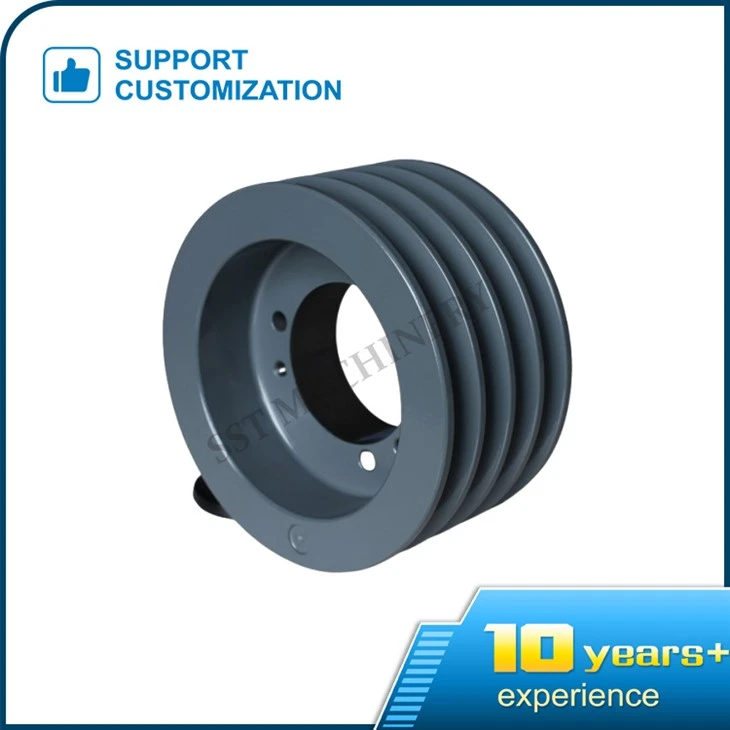
Rubber Belt Sheave
Production process flow of rubber belt sheave.
The rubber belt sheave is a common transmission component in mechanical equipment, mainly transmitting power through the frictional force between the belt and the pulley groove. Below, from material selection to finished product inspection, let's talk about its processing flow in detail.
The materials are usually gray cast iron or ductile iron, which have low cost, good wear resistance, and are suitable for mass production. Aluminum alloy is also useful in situations where weight reduction is required. After the raw materials enter the factory, they undergo spectral testing to ensure that the composition meets the standards. In the casting workshop, workers pour molten iron into the pre made sand mold. The mold is made in advance using wooden or metal molds according to the pulley model, leaving grooves and spokes in the mold cavity. During pouring, the temperature of the molten iron should be controlled at around 1350 ℃. If the temperature is too high, it can easily cause porosity, while if it is too low, it can lead to insufficient pouring.
After the casting cools down, it needs to be cleaned of sand by using a shot blasting machine to remove surface sand particles. The quality inspector holds a caliper to measure the size of the blank, focusing on checking whether the wheel groove angle is accurate and whether the wheel flange thickness is uniform. Raw materials with insufficient watering or cold insulation defects are directly scrapped. Qualified products are transferred to the machining process. First, the end face and outer circle are roughly machined on a regular lathe, leaving about 1 millimeter of precision machining allowance. The operator will use a dial gauge to align the workpiece during installation, ensuring that the end face runout does not exceed 0.1 millimeters.
Precision machining is completed on a CNC lathe, and the trapezoidal angle of the wheel groove is set in the program. When processing the wheel groove, a specially designed forming knife is used, and the shape of the knife head matches the cross-section of the wheel groove perfectly. Workers need to conduct a random inspection every 20 pieces they process, and use a projector to magnify 50 times to compare the contour. The drilling process requires attention to the roughness of the hole wall, and the aperture tolerance should be controlled at H7 level. If a customer requests a taper hole, a specialized reamer will be used for processing, with a commonly used taper of 1:10 or 1:15.
Dynamic balance testing is a crucial step. Install the rubber belt sheave on the balancing machine to rotate, and the equipment will automatically detect the amount of imbalance. The operator marks the spokes and uses a drill bit to remove the material at the corresponding position. The allowable unbalance of small pulleys is within 5 grams per millimeter, while the requirements for large industrial use are more stringent. A few small dents can be seen on the inside of the wheel that has been balanced, which are adjustment marks.
Surface treatment should be selected according to the intended use. Spray paint is used for rust prevention in ordinary environments, and the paint must undergo salt spray testing. Food machinery should use electroplating with a coating thickness of at least 8 microns. For those with heat dissipation needs, heat dissipation holes will be machined on the spokes. At this time, special attention should be paid to deburring the edges of the holes to prevent scratching the belt during operation. In the final quality inspection stage, in addition to dimension retesting, hardness inspection is also required. A Brinell hardness tester is used to mark points at the wheel rim to ensure compliance with the HB180-220 standard.
Before packaging, each rubber belt sheave should be coated with anti rust oil and individually wrapped with bubble wrap. When storing goods in the warehouse according to order classification, products of the same specification should not be stacked in more than five layers to prevent deformation. Many manufacturers are now using lost foam casting technology, which can produce more complex spoke structures, but the mold cost is about 30% higher than traditional sand molds.




Hot Tags: rubber belt sheave, China, suppliers, manufacturers, factory, customized, wholesale, for sale, made in China
Previous
Sheave And PulleyNext
Sheave WheelYou Might Also Like


Send Inquiry