




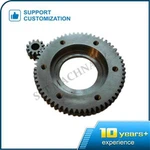


Synchronous Belt Pulley
The synchronous belt pulley shall be applied to a variety of equipment, with accurate and stable mechanical transmission, stable equipment operation and good environmental applicability. The transmission advantages of the synchronous belt pulley are embodied as follows.
Since the synchronous belt pulley will not produce any pollution in the transmission process, it can be used in an environment that does not allow pollution. Through the optimized transmission effect, the operation and functional advantages of the equipment can be ensured. In this way, the equipment with high cleanliness requirements can be used in transmission. The synchronous belt pulley will not produce use pollution, will not be affected by environmental factors, and will not affect the operation and transmission effect. It can also rely on its own wear resistance and corrosion resistance to avoid the adverse effects of harsh environment. Therefore, it can also adapt to normal work in harsh places.
The synchronous belt pulley realizes high-efficiency transmission through high-speed transmission and constant transmission ratio, and has good energy-saving effect in application due to its own structural characteristics. At the same time, it also uses these advantages to reduce the operation cost of the equipment.
Since the synchronous belt pulley can work in harsh working environment and provide more efficient transmission power output, it is widely used in the fields of automobile, textile, office equipment, laser engraving equipment, financial equipment, financial equipment, tobacco, stage lighting, food machinery, medical machinery, communication, petrochemical, instruments, precision machine tools, etc.
Since synchronous pulley is an important part, it is generally made of steel aluminum, alloy cast iron, brass and other materials. Generally, the places of use are different, and the final materials will be different. Of course, our parts will undergo some special treatment before use, such as natural color oxidation, galvanizing, high-frequency quenching, etc.
When designing a Synchronous Belt Pulley system, the first step is to select the belt that best suits the application. But the pulley also plays a major role in how the belt performs, especially in a synchronous belt drive system, where the proper engagement of the pulley teeth with the pulley grooves affects everything from the amount of torque that can be transmitted to belt speed to wear and potential failure modes.
Synchronous belt and timing pulleys are typically designated by the number of grooves (analogous to the number of teeth on the belt), groove pitch (analogous to the belt tooth pitch), and pulley width.
The required tooth pitch (and, therefore, groove pitch) is determined during belt selection, based on the design torque and speed. Torque and speed are also the primary factors in determining belt width, and, therefore pulley width. (Recommended pulley width is typically slightly larger than the belt width and takes into account the space required for pulley flanges.) The number of pulley grooves is determined by the required speed ratio.




Hot Tags: synchronous belt pulley, China, suppliers, manufacturers, factory, customized, wholesale, for sale, made in China
Previous
H Timing PulleyYou Might Also Like


Send Inquiry